World Music Concepts: Music of South America and the Caribbean
Introduction
Here we are at lesson 9! This is our travel week, and we'll be exploring the music of Jamaica and Cuba, along with Brazil and South America (especially, Andean pan pipe music). We will study the many musical styles that came from these colorful places and how they can be used in your compositions. In many of the workshops of this lesson you will get to practice writing rhythms based off of Jamaican, Cuban, and Brazilian styles. In the lesson 9 assignment you will create a short composition using Caribbean and/or Brazilian rhythmic elements.
In Composers on Composing, we'll be asking our artists when and where do they compose.
So, let's get this musical journey started!
Objectives
By the end of the lesson, you will be able to:
identify unique elements of old and new Jamaican music and compose music using those elements
understand the connection between the Baroque chaconne and its South American origins and compose a nueva chaconne
identify and compose music using rhythms unique to Cuban music
identify unique elements of Andean pan pipe music and compose music using those elements
understand and comment on how the work of a selection of professional composers from South America and the Caribbean are influenced by their culture
World Music Concepts: Beats and Island Breezes
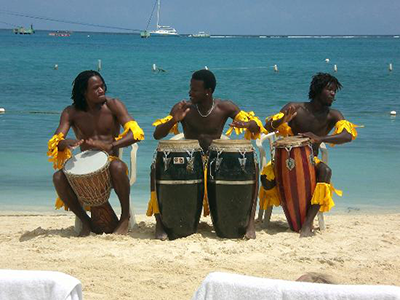
Jamaica is a small island in the Caribbean with a big sound, and is perhaps best known for reggae music. But before Bob Marley and the development of reggae, Jamaica had a rich musical heritage based on the music of Africa blended with the music of Europe. Let's begin our Jamaican exploration by going back to the fifteenth and sixteenth centuries.
Maroons Style Music
African slaves were brought to the Caribbean islands beginning in the late fifteenth century to work in sugar cane plantations and do other laborious, and often inhumane tasks. When the British captured Jamaica in the mid-seventeenth century and the Spanish fled, many of the slaves escaped and started their own villages, hidden in the mountainous regions of Jamaica and other islands. The escaped slaves were called "Maroons." Their music had a direct link to Africa, and due to the inaccessibility of their villages and their wish to remain free and hidden, their music remained mostly unaltered for many decades, and even up to recent times. In Jamaica, the Maroon music is at the root of reggae and other twentieth-century Jamaican styles. The Maroons were primarily of West African descent. They developed a music and dance tradition and ceremony called "Kromanti Play." The name is derived from a historical slave port on the Gold Coast of West Africa.
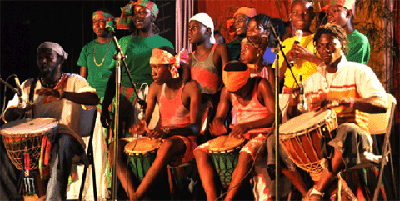
The instrumental ensemble that normally accompanied the dance consisted of a pair of long cylindrical drums, one representing males and one females, each called "printing;" a length of bamboo tubing called a "kwat;" and a machete blade called an "adawo" played with a metal beater. The adawo has a role similar to the bell in West African music and many of the rhythm patterns for the adawa are derived from West African bell rhythms. The printing drums play "cutting" and "rolling" rhythms that feature syncopations and polyrhythms similar to the West African drum patterns.
Most traditional West African melodies are major or minor pentatonic. In "Hear When De Duppy Bawl" we can hear a clear European influence in the melody which uses the B
Structure: the same phrase structure that developed into the 12-bar blues. The European-influenced melody is accompanied by traditional West African drums.
"Hear When De Duppy Bawl," performed by Maroons of Moore Town, Jamaica
Mentos Style Music
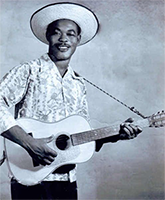
Count Lasher
In the mid-twentieth century, the music of the Maroons and various folk styles melded into a style of music called mento. Mento is often referred to as Jamaican calypso. Despite that, as you listen to the mento star Count Lasher's "Island Gal Sally," you'll hear the strong backbeat that became associated with reggae and other styles of Jamaican music. Mento instrumentation is primarily acoustic, with voice, guitar, banjo, bass, drums, and saxophone, heard in this recording.
"Island Gal Sally," Mento Guitar and Banjo Backbeat:
Count Lasher. "Island Gal Sally" from Jamaican Mento Music Hits (1952 - 1958) (BLACK ROUND RECORDS 2012)
Sound Systems and Ska
The 1950s brought a number of new styles, including mento, to Jamaica. Along with the new styles came sound systems—large portable amplifiers and speakers through which vinyl records were played very loudly. DJs would bring their sound systems, powered by generators, all over the island and create instant street parties. American rhythm and blues was a favorite, but Jamaica's own version, ska, was another powerful and hugely popular style. Ska music featured the heavy backbeat of mento mixed with strong guitar upbeats creating an infectious, syncopated danceable blend. "My Boy Lollipop," recorded by Millie Small in 1964, became an international ska hit.
"My Boy Lollipop," Guitar Off-Beats:
Millie. "My Boy Lollipop" from My Boy Lollipop: The Best Of Millie Small (spectrum 2016).
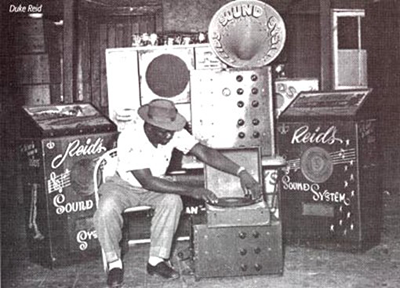
Duke Reid's Sound System
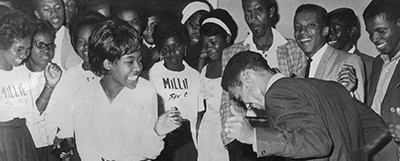
Ska Music Led to the Invention of Several Dances to Go with the New Music
Rocksteady Style Music
The pop and R&B-influenced sounds of ska faded in the 1960s and the somewhat slower tempo of rocksteady began to dominate. Rocksteady was less horn-section oriented and focused on vocals, guitar, bass, and drums. Listen how the steady, easy, syncopated electric guitar groove of Desmond Dekker's "Shanty Town" blends mento and ska rhythms into something slightly new, creating a distinct style.
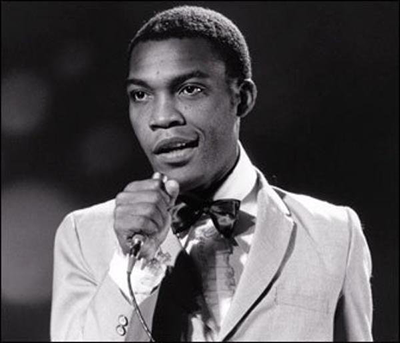
Desmond Dekker
Desmond Dekker's "Shanty Town" Groove:
Desmond Dekker. "0.0.7 (Shanty Town)" from The Best of Desmond Dekker (Sanctuary 2013).
Jamaican Toasting
Another Jamaican musical innovation was called toasting. Jamaican DJs with their portable sound systems played a number of beats (recordings with the vocals removed) they called "riddims" over which they would do a sort of rhythmical chanting that came to be known as toasting. Jamaican toaster DJ Kool Herc took this style to Queens, New York and it became the foundation of rap and hip-hop. Here is a recording of another seminal Jamaican DJ, King Sporty, toasting over the rhythms (or riddims) of "For our Desire." The syncopated offbeats and simple progressions of mento, ska, and rock steady remain a big part of the sound.
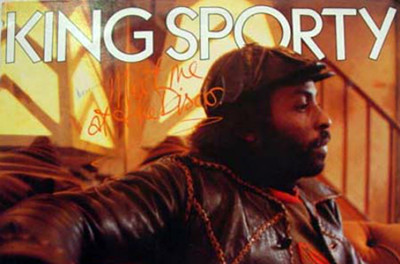
"For our Desire," Toasting:
 |
(missing audio)
|
Reggae Style Music
When most people think about Jamaican music, they think about reggae music and Bob Marley. Reggae grew out of mento, ska, rocksteady, and other Jamaican dance styles. The earliest reggae songs are ftom the late 1960s. "Long Shot Kick De Bucket," recorded in 1969 by the Pioneers, a vocal trio, is reputed to be one of the first true reggae songs. (Be sure to also check out the Maytals' "Do the Reggay" from 1968.) You'll notice in most examples of reggae, the guitar syncopations are pared down to primarily sharp accents on two and four, and the beat is somewhat slower than ska.
"Long Shot Kick De Bucket":
 |
(missing audio)
|
Pioneers. "Long Shot Kick de Bucket" from Give and Take - The Best of the Pioneers. (Sanctuary/2013).
Rastafari
We can't talk about reggae without mentioning Rastafari, a religion/social attitude that Bob Marley and other early reggae stars practiced. Rastafari is based on the belief that Haile Selassie I, crowned Emperor of Ethiopia in 1930, would lead the righteous to the perfect world called Zion. Rastafarians believe the use of cannabis will help them in their spiritual quest. At times, Rastafari is also a political and social movement that rejects materialism, oppression, and sensual desires. Rastafarians also did not cut their hair, growing them into dreadlocks, due to scripture that forbade them from doing so. Thus, Bob Marley and other Rastas had an easily identifiable look. Peter Tosh was another big figure in reggae music and along with Marley and Bunny Wailer, was one of the original members of The Wailers. After Burnin', the band's second album for Island Records, the other two original members left the group to pursue solo careers, and the name was changed to Bob Marley and the Wailers. Here is a version of the Wailers' song "Get Up, Stand Up," written by Marley and Tosh. The reggae beat is now slowed down, though still with its slashing guitar backbeats. "Get Up, Stand Up" is a song written using essentially only one chord: G minor. Although it is a reggae song, it is clearly a song with a political and social justice theme.
Get Up, Stand Up:
Peter Tosh "Get Up, Stand Up" from Equal Rights (CBS 1977).
As reggae evolved, an even sparser syncopation became part of the music. It was called one drop. One drop was a technique where the first kick drum beat (beat one) was dropped, leaving the kick drum and snare drum accenting beat three. This gives the music an exceptionally laidback feel, with lots of space.
Bob Marley and the Wailers' "One Drop," Kick and Snare Groove:
Bob Marley. "One Drop" from Survival (Island Records 1979).
Reggae Subgenre of Dub Music
A number of subgenres grew out of reggae and the other Jamaican music styles. One genre that has spread through the world is dub. Essentially, dub music is produced by removing the vocal tracks from a recording and remixes the existing recordings to create new music. Often, effects such as reverb, delay, echo, and other studio effects were added to the tracks. Sometimes, new vocals and instruments were added (dubbed) to the tracks. This was a very popular Jamaican technique that is the foundation of remixes we hear today.
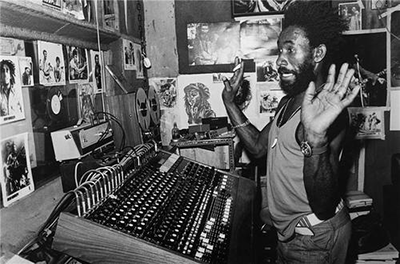
Lee Perry at Black Ark Studios
"Rubba, Rubba, Words" is from a 1973 album by the Upsetters called Blackboard Jungle Dub. It is one of the earliest dub recordings, and the effects seem rather tame compared to recent remixes. The reggae sound and influence is quite obvious.
"Rubba, Rubba, Words" by the Upsetters:
 |
(missing audio)
|
A more effects-oriented sound was created by Mad Professor. Here is a taste, "Foot Control Mix," from his 1983 album Escape to the Asylum of Dub:
Mad Professor, "Foot Control Mix":
 |
(missing audio)
|
Reggae has branched off into many sub-genres such as roots reggae, ragga, reggae fusion, and reggaeton. Reggae music still has an attentive audience and Jamaican music continues to evolve.
Workshop: Jamaican Styles Matching
Listen to the excerpts of Jamaican styles below by mousing over each example. Then match the name of the style with the correct musical example by dragging and dropping it into one of the boxes. Keep trying until you match all examples.
World Music Concepts: Bach to Brazil
An Introduction to the Music of Brazil and South America
The music of South America and Latin America is as rich and varied as the music of Jamaica. And, as we have covered just a small part of Jamaican music, now we will survey a swath of South American music, but concentrate on the music of Brazil, and in this limited space, even just a small selection of that.
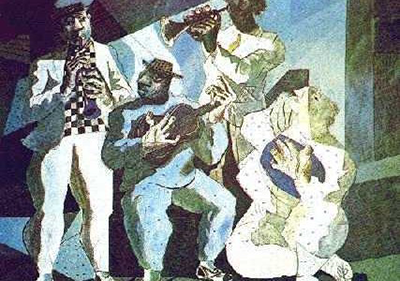
Obras de Candido Portinari
When the conquistadors and other Europeans arrived in the Americas, they quickly decimated the native population through warfare and disease. Therefore, much of the indigenous music did not survive. We are left with only ancient instruments, such as clay flutes, and paintings and sculptures to imagine what the music may have sounded like.
The Europeans colonized the Caribbean and South American continent setting up plantations, distilleries, and mines. In order to operate these labor-intensive endeavors, the colonizers imported hundreds of thousands of slaves from Africa. The African slaves brought their music along with them. Therefore, the music that developed in the Caribbean and South America is a mix of African, European, and indigenous music.
The Chaconne
One of the first new musical forms that emerged from South America was the chaconne. The South American version was a sexy, swirling dance in triple meter and it took Europe by storm in end of the sixteenth century. The chaconne is a variations form based on a repeating chord progression. The earliest chaconnes were probably played on Spanish and South American-style guitars that accompanied mocking and bawdy lyrics. The Spanish progression that is the basis of the Eagles' mega hit "Hotel California" is essentially a chaconne.
Below is an excerpt from Juan Aranés' (early sixteenth century, d. 1649) chacona "Un Sarao de la Chacona." You will hear the bouncy triple meter that stresses beat two. The rhythm is highly infectious and danceable in a syncopated Spanish style. Listen to this modern interpretation of the Aranés' chacona that includes guitar, drums, brass, clapping, foot stomping, and vocals. It is a wonderful blend of European and uniquely South American sounds.
Juan Aranés "Un Sarao de la Chacona":
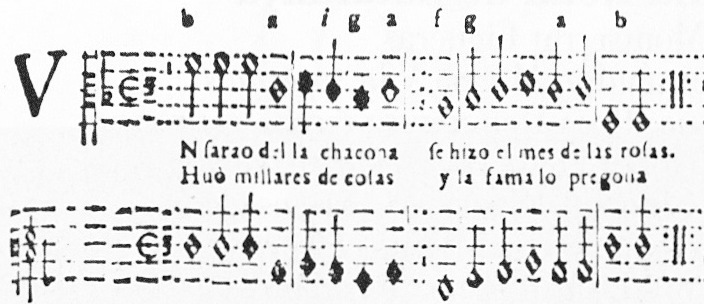
Juan Aranés "Un Sarao de la Chacona"
 |
(missing audio)
|
Violin Partita in D
Baroque period (1600-1750) composers such as Monteverdi, Schütz, and Johann Sebastian Bach used the chaconne form in their classical music compositions. The best known of these Baroque chaconnes is Bach's 256-measure chaconne from the final movement of his Violin Partita in D. In Bach's hands the chaconne is highly stylized and the mocking lyrics are gone as is the swirling dance. However, Bach's immense powers of musical development and imagination make his Partita one of the great works of the Baroque era.
The following example shows the first measures of Violin Partita in D.
Bach's Manuscript Violin Partita in D:
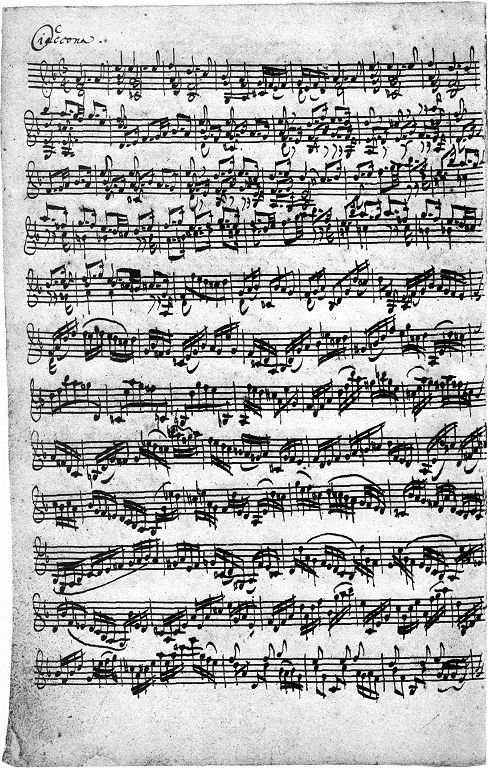
A Modern Score of the Opening Bars of Bach's Violin Partita in D:
An Analysis of the Opening Bars of Bach's Violin Partita in D:
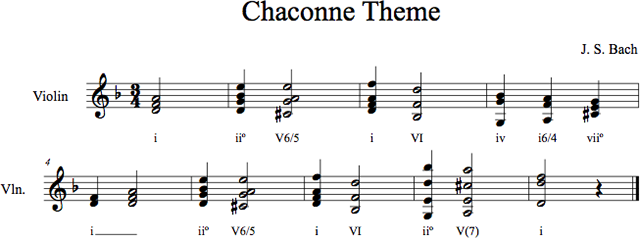
Because the violin cannot play four-note chords, you will hear the violinist play fast sweeping arpeggios of the chords.
The early chaconne shows the influence of popular music of the Americas that include the syncopated rhythms of Spain as well as the African influenced polyrhythms. As the years went by, Latin American music became more and more influenced by the growing African population.
The Samba
The samba has become one of the most important music and dance genres in Latin music. The samba has become a major part of the Brazilian national identity. Like the chaconne, the samba derived from a mix of European and African music. However, unlike the chaconne, the samba is heavily rooted in the African rhythms of Angola and the Congo. The modern samba is primarily in 2/4 meter with heavy accents on the second beat of each measure.
Typical Samba Rhythm:

"Lenço no Pescoço"
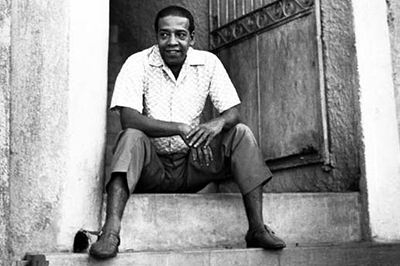
An early recording of Brazilian samba is by Wilson Batista. His "Lenço no Pescoço" (Scarf around the Neck) is a mix of a jazz era (1920-1940) rhythm section (although the four-string cavaquinho replaces the guitar or banjo) and clarinet with vocals. The samba rhythmic pattern is strong and clear. Another rhythmic layer is added to the sound by the tamborim that plays an African double-bell pattern.
Wilson Batista
African double-bell pattern in the tamborim:

Lenço no Pescoço:
 |
(missing audio)
|
Brazilian Carnaval
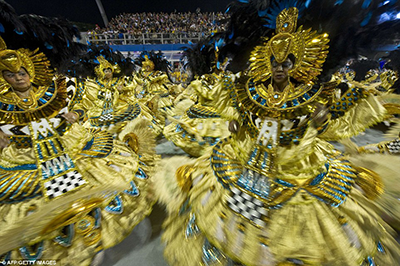
As the samba developed, it became a staple of the Brazilian Carnaval. Escolas de Samba, organizations that put on parades during Carnaval season, became important cultural institutions and many, many people wanted to participate. Part of the Escola de Samba was the percussion and drum section called the bateria. The bateria created a thundering beat as revellers marched during Carnaval.
Carnival
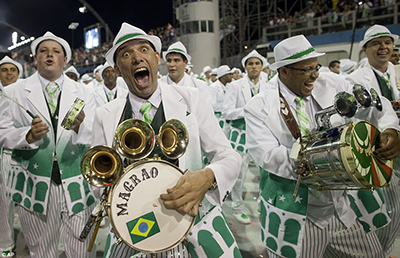
Carnival
"Chica Chica Boom Chic"
Carmen Miranda sang "Chica Chica Boom Chic" in the 1941 Hollywood movie That Night in Rio and helped popularize the samba in the United States and abroad. The samba pattern in the song is shown in the example below. It is very similar to the Batista pattern. The surdo, a bass drum played with a wooden stick that functions as the bass in the bateria in an escola de samba, provides the heavy, low syncopation on the second beat.
"Chica Chica Boom Chic" Samba Rhythm:

Carmen Miranda Sings "Chica Chica Boom Chic":
 |
(missing audio)
|
"Kid Cavaquinho"
Samba has continued to be a rich and vibrant source of musical inspiration and expression. Listen to "Kid Cavaquinho" by Conjunta Explosão do Samba and see if you recognize the African bell pattern and typical samba rhythms.
"Kid Cavaquinho" by Conjunta Explosão do Samba:
 |
(missing audio)
|
The Choro
Choro has been described as "the New Orleans jazz of Brazil." It began as most Brazilian forms did, as a mixture of African rhythms and European popular music forms such as the polka, waltz, and mazurk, as well as the Cuban habanera. Through time it developed into a more complex improvisational music that featured large melodic leaps and surprising modulations. According to Brazilian singer Aquiles Rique Reis, "choro is classical music played with bare feet and callus on the hands."
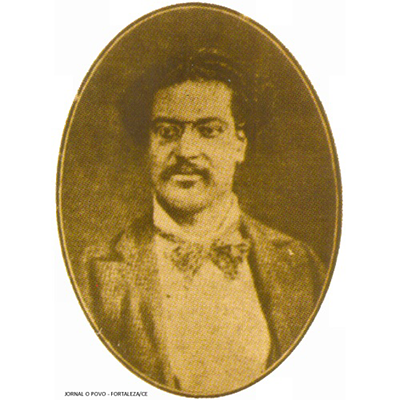
Joaquim Callado
The word choro, in Portuguese, means "to cry." The name comes, perhaps, from the weeping sound and style that is produced by the clarinet or flute that often played the melody in these instrumental ensembles. The first choros were somewhat melancholy, so perhaps, although later choros were most often upbeat, the name stuck. A typical choro band is made up of a solo instrument, the cavaquinho (Brazilian guitar), guitar, and sometimes percussion. "A Flor Amorosa" by Joaquim Antônio da Silva Calado is often considered to be the first choro written. Calado was reputed to be an excellent improviser on the flute. His band, Choro Carioca, formed in the 1870s, consisted of flute, two guitars, and cavaquinho. The choro music was played in the cafes of Rio de Janeiro and was a virtuosic music that was intended to sound improvised and spontaneous.
"A Flor Amorosa" by Joaquim Antônio da Silva Calado:
Jacob do Bandolim was another famous choro composer, penning 103 tunes. He was also a wonderful mandolin player and bandleader. His stage name (Jacob do Bandolim) means "mandolin Jacob."
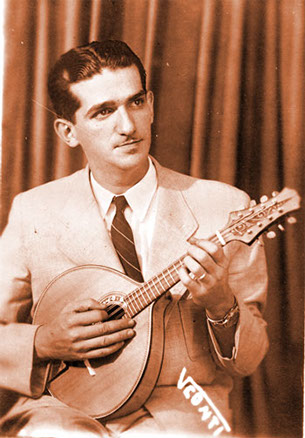
Jacob Do Bandolim
Let's listen to and analyze the first large section of his famous choro "Doce de coco." The title phrase is Portuguese for "sweetheart" or "sweetie."
Jacob Bandolim performing "Doce de coco":
Jacob do Bandolim. "Doce De Coco" from Original Classic Recordings Vol. II (Acoustic Disc 1994).
"Doce de coco" exhibits many of the characteristics that make up the choro style:
The melody is syncopated, improvisatory-sounding, with a primary motif consisting of melodic leaps. The chord progression is solidly tonal, yet brushes on many key centers. The piece begins in G major, flirts with A minor (the section is not long or strong enough to call it a modulation) in bar 7, returns to G major in bar 11 and again brushes with A minor in bars 14-16. A strong cadence (V7 to I-) brings the listener back to G, but this time in the parallel minor before cycling back to G major in bar 29.
In addition to the insinuated key changes and change of mode, this first section also has two strong line clichés. The first is a chromatically descending/ascending line in bars 7-9 on the A minor chord, and the second is an ascending/descending line on the G minor chord in bars 19-22.
The harmonic palette in this first section is extremely rich, using secondary dominants, a substitute dominant, borrowed chords, a secondary-function diminished chord, and a change of mode. All of these elements create a sophisticated and colorful composition.
Choro in the Classical World
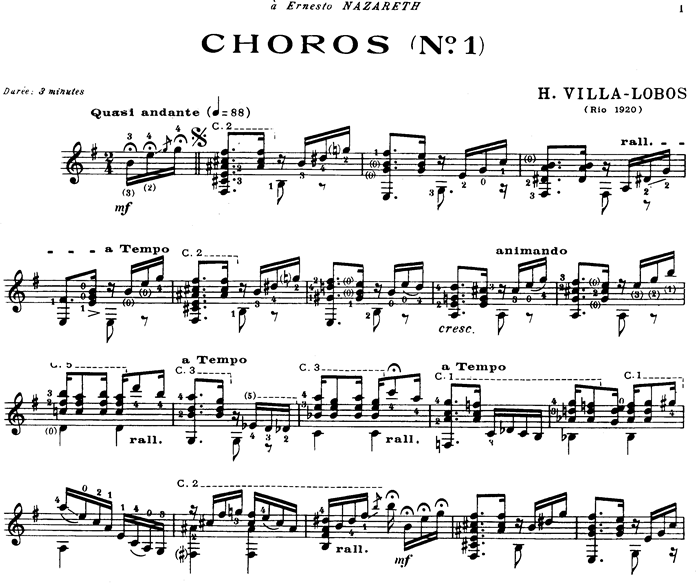
The choro was such a powerful force in Brazilian music that classical composers were seduced by its harmonies and infectious rhythms. Heitor Villa-Lobos is regarded as the finest and most influential Brazilian composer of the twentieth century. He, too, was drawn to the charms of choro. Villa-Lobos composed more than 2,000 works, ranging from large-scale orchestral pieces to intimate music for solo guitar. He composed a series of choros (No. 1-14) for various instrumentations between 1920 and 1929. His "Choros No. 1" is for solo guitar and captures the syncopated rhythms and angular melodies of choro.
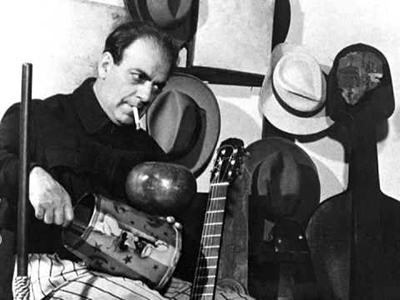
Heitor Villa-Lobos
Listen to the recording and follow the score to this wonderful piece for solo guitar.
Heitor Villa-Lobos "Choros No. 1":
Heitor Villa-Lobos. "Chôros No. 1 for Guitar, W161." from Villa-Lobos: Chôros No. 1 for Guitar, W161 (Digitally Remastered) (Essential Media Group LLC 2015)
Brazilian music has spread across the globe and has delighted many listeners and inspired numerous composers and performers. The rich combination of subtle, yet surprising harmonies, syncopated rhythms, and interesting melodies, create a musical gumbo that includes African, European, and native South American influences. This topic has just scratched the surface of Brazilian music. It would be clearly worth your time to investigate this multi-faceted music in a deeper way.
Workshop: "Choro No. 1" by Heitor Villa-Lobos Analysis
Analyze the first 16 bars of "Choros No. 1" by Heitor Villa-Lobos providing chord symbols and contemporary-style Roman numerals.


Workshop: Brazilian Music Styles Matching
Listen to the excerpts of Brazilian styles below by mousing over each example. Then match the name of the style with the correct musical example by dragging and dropping it into one of the boxes. Keep trying until you match all examples.
World Music Concepts: Rhythms of Cuba
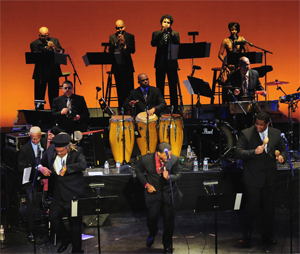
Afro Cuban All Stars
Cuba is a Caribbean island that has a rich and vibrant musical heritage and tradition. Similar to Jamaica and Brazil, the music of Cuba has a mix of European, African, and native influences. As in other Afro-Latin music styles, the African bell pattern that we explored in Music Theory and Composition 2 has been adapted to be the heartbeat of much of the Afro-Latin music. In Cuban music, variations of the African bell pattern morphed into the clave that is the foundation of many Cuban and Latin styles.
Clave and Son
Clave
"Clave," in Spanish, means "the code" or "the key" and creates the timeline and rhythmic underpinning of a lot of Cuban music. In African music, the timeline was kept by the double bell that became the agogo bell timeline in Brazilian music and the pair of hard wooden sticks called "clave" in Cuban music. The Cuban clave rhythm is a five-stroke pattern that is loosely derived from the African bell rhythm.
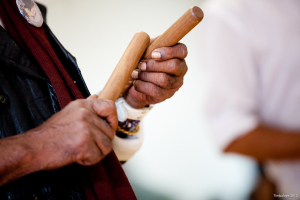
Clave
The clave pattern is played in two ways: the 3-2 clave and the 2-3 clave. What this means is that in 3-2 clave there are three attacks in the first bar and two attacks in the second bar. The 2-3 clave is the opposite. The exact rhythm of these attacks varies according to style.
Son
Son, derived from the Spanish word for rhythm, is one of the oldest Afro-Cuban styles of music. Son gave birth to a variety of styles including salsa and the modern timba (more on both of these genres soon!). Son is thought to have coalesced as a style around 1910 when Spanish-derived vocal music was combined with African-style drumming and the five-stroke clave pattern.
3-2 Son Clave Pattern:

2-3 Son Clave Pattern:

"El Manisero"
A recording of Rita Montaner's "El Manisero" took Paris by storm in 1928. In the recording, you can hear the five-stroke clave rhythm that fuels the beat in a rather gentle way.
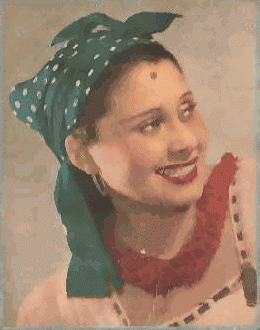
Rita Montaner
Rita Montaner's "El Manisero" from 1928:
 |
(missing audio)
|
"Alegre Conga"
Trio Matamoros, consisting of three vocalists who played guitars and percussion instruments, represent the high point of son in the 1930s. The trio was hugely popular and successful. The characteristic clave of the son is heard in a limited fashion. In the example below, Trio Matamoros perform "Alegre Conga."
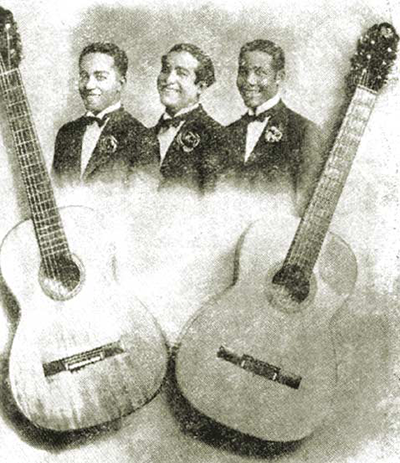
Trio Matamoros
"Alegre Conga":
 |
(missing audio)
|
"Dame un Cachito pa' Huele?"
In the 1940s, the popularity of son began to fade as American jazz and big bands became the rage. The acoustic Cuban son began to be integrated with electric instruments, trumpets, and larger rhythm sections that included drum kits.
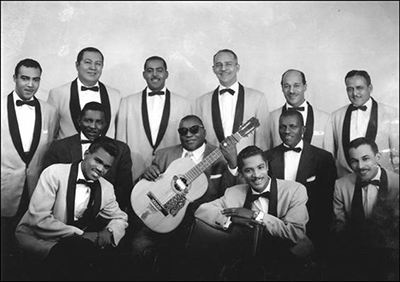
The next example is from Arsenio Rodríguez, a son legend who began the trend towards the big band sound that would dominate the Cuban music scene in the 1950s. The clave is still present in Rodríguez's music but its sound is now integrated into a larger percussion section. In the photo below you can see that Arsenio has a pick-up on his guitar so he can be heard over the larger and louder band.
Arsenio Rodríguez and His Group
 |
(missing audio)
|
Salsa
Salsa, which is Spanish for "hot sauce," is a genre of music that is a descendent of son and other Afro-Cuban styles, but was also highly influenced by other Latin styles and American jazz. Salsa is often faster than son and is often written in 2/4 meter. The salsa clave is similar to the son clave. Although salsa music has Cuban roots, it was created by Cuban-American musicians in New York and later exported back to Cuba and Latin America. Many performers of salsa say it is just another name for the vast ocean that is modern Cuban music. In addition to salsa being a huge Latin music genre, it is also an internationally practiced Latin dance form.
Salsa Clave in 2/4:
Salsa, and even some son, is played in 12/8 meter. The 12/8 clave is very similar to the African bell pattern.
Salsa Clave in 12/8:
Celia Cruz
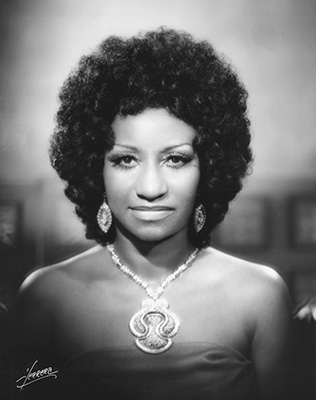
Celia Cruz has been called "The Queen of Salsa." In the example below, we hear her "Son Con Guaguancó." The American big band influence is clear, yet the incessant beats of Afro-Latin percussion are obvious.
Celia Cruz
Celia Cruz' "Son Con Guaguancó":
 |
(missing audio)
|
Tito Puente
The New York sound of salsa and Latin music is exemplified by "The King of Latin Music," Tito Puente. Although not of Cuban descent, Puente popularized Latin music and brought it to international prominence through his hot salsa rhythms and syncopations. Tito Puente played the timbales, a pair of shallow drums with metal casing. They are drums of Cuban origin and play a large role in modern Latin music.
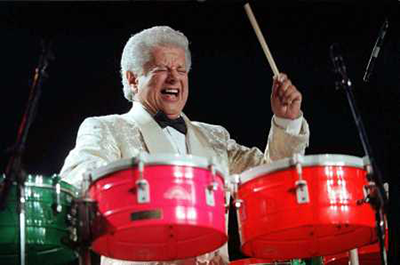
Tito Puente
Tito Puente's "Salsa Y Sabor":
 |
(missing audio)
|
Timba
Timba is a newer addition and faster-paced version of Cuban son-derived salsa that has become a dominant sound in Cuba today. It draws on African folk dances and rhythms like rumba, but also R&B, rap, and reggae.
Many timba musicians are purposefully breaking the basic rules of clave and creating a "cruzado" (incorrectly crossed) style in which the performers and composers are taking creative license to go beyond the strict bounds of traditional clave. Alain Pérez, the composer of "Sandunguita," which employs cruzado, says that this is a natural extension and evolution of the music. A less sensitive non-Latin ear may not hear a drastic difference. The rhythms are a bit more syncopated and layered, but the essential Latin sound is still there.
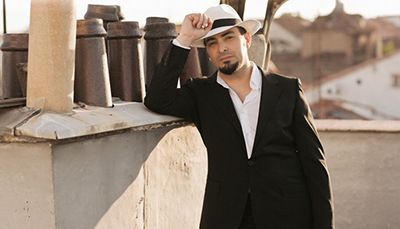
Alain Pérez
Cruzado in Alain Pérez' "Sandunguita" performed by Issac Delgado:
 |
(missing audio)
|
Workshop: Cuban Rhythm and Tempo Matching
Listen to the excerpts of Cuban rhythms styles below by mousing over each example. Then match the name of the style with the correct musical example by dragging and dropping it into one of the boxes. Keep trying until you match all examples.
World Music Concepts: Pan Pipes and Hocket
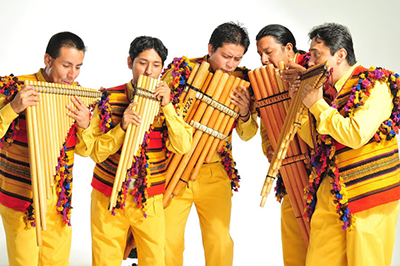
Legend has it that siku (Andean pan pipes) were played by women descending from the mountains. The full siku that encompassed all of the notes was too large to carry and play by oneself, so two smaller siku were made as a pair that together could play the full range of notes. A siku player would find a partner to complete the scale and the two would be bonded together and neither could play with another for the remainder of their lives.
Pan Pipes
Siku are made from dried hollow reeds of different lengths cut to sound specific notes. The hollow reeds are then fastened together to be a complete set. To play the pan pipes the performer would blow over the open top of the tube to create a note, much like blowing over the opening of a bottle. Each of the two siku has a specific attribute. The ira is regarded as male and the arka as female. Two performers were required for a performance. Modern siku have both rows of tubes and are most often played by a single musician.
Here's demonstration of Andean Pan Pipe music from Bolivia and Peru:
Zbigniew Kubisz. 2014.
The "Hocket" Concept
To get the concept, imagine two instruments, one that can only play the notes C, E, and G, and one that can only play the notes D, F, and A. However, the song (we'll use "Twinkle, Twinkle, Little Star" in this case) has all six notes. Let's see how that could be worked out.
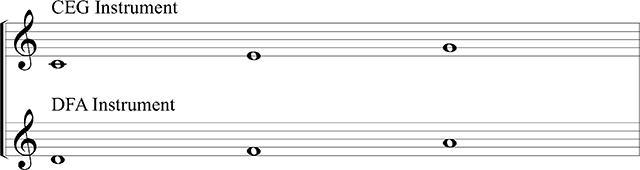
The melody we want to play is shown below:

Here's how this could be played on our two imaginary instruments:

The technique used to divide the single melody line between two instruments is called "hocket" in European music. We'll explore it in more depth than "Twinkle, Twinkle" in a moment.
Andean Musical Examples
"Kusisiri"
Listen to "Kusisiri" by the Bolivian pan pipe and folk music group Ruphay. Better yet, listen to it with headphones or a good stereo and you will hear some of the pipes on the left and the remainder on the right. Together, they trade quickly back and forth to make a complete melody and harmony. The tune is in the G
The siku comes in many sizes, allowing the melody to be played an octave lower and an octave higher in a kind of heterophony (the same melody played simultaneously with slight variations). The largest siku in an ensemble is called tayca irpa, "the grandmother who leads." Andean siku music is often heard in parallel fourths and fifths, creating a rich almost medieval Western European sound. Because of the passage of time, the influence of Western instruments and music, and the lack of notated music, we can't be certain that the siku were always tuned the way we hear them today or played in today's fashion. However, the Andean tradition of playing siku music goes back many, many centuries before the Incan Empire.
Reed, ceramic, metal, and bone instruments have been found from which ethnomusicologists have been able to identify the scales used by the performers and found complementary pairs, and even trios, of siku. In performance, siku are often accompanied by large double-headed drums, and sometimes, a triangle. In this modern recording a snare drum has been added to the ensemble.
Dividing a single line into two parts to create a complete melody by performing it on two instruments was a very clever idea. It also ensured that the music was communal. Additionally, due to inaccessibility in the high mountains, each community developed its own tunings and style of playing.
Louis Girault's Bolivia Field Recordings
Louis Girault
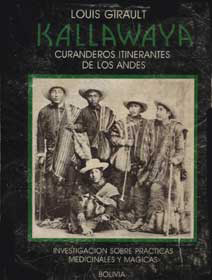
Louis Girault, a French ethnomusicologist, made field recordings between 1955 and 1973 in communities of the Altiplano (high plains) of Bolivia. The songs he recorded were said to date back to pre-Columbian times (the time before Christopher Columbus and other European explorers came upon the Americas). The following three recordings come from his trips in which he often transported his heavy recording equipment in a wheelbarrow or on a mule.
"Kacharpaya"
In the example below, "Kacharpaya," is played by 18 siku and five drums. The song is played to a visitor to wish him or her a safe trip home and a hope that he or she will return soon.
The song is played in octaves and the scale is E minor. The 6th degree is not heard, so one can't tell if it is Aeolian or Dorian. Interestingly, it ends on a long held B.
"Yaku"
The example below, "Yaku," is from the Chari community. The siku play in parallel 4ths and 5ths in the key of F minor. The music accompanied a solemn and aristocratic dance where couples dance face to face.
"Komer Chakra"
The next example, "Komer Chakra," is from the Kaalaya community. "Komer Chakra" sounds in the key of A
"Hocket"
Interestingly, a similar style of divided melody was popular in vocal and instrumental music in the medieval (1200-1450) period in Europe. Melodies were divided among two or more singers or instrumentalis creating a "hiccup." The word "hocket" was derived from the French word "hoquet" that means a "a sudden interruption, a glitch, or hiccup."
"Hoquetus I-VII" from the Bamberg Codex (Bamberg, Staatsbibliothek, Lit.115), has seven pieces of instrumental hocket. Listen how the melody line is divided between the instruments.
Hocket is an old idea that has roots in the Altiplanos of Bolivia as well as central Europe. Imaginative composers have employed hocket for centuries, and hocket has even found a place in the music of today. David Longstreth, singer, composer, and guitarist for the indie rock group Dirty Projectors, tells how he uses hocket in his music. The song in question, is called "Gimmie Gimmie Gimmie," and is a drastic reinterpretation of a song by the hardcore punk band Black Flag. As far as we know, Black Flag themselves never employed hocket in any of their songs.
David Longstreth Talks Hocket (content starts at 6:00):
Hoketus
Louis Andriessen, a Dutch contemporary classical music composer, wrote a wonderful piece named "Hoketus." It uses the hocket technique in a unique modern way. The composition is 24 minutes long, so feel free to fast forward to hear the development if you are not inclined to let it unfold slowly.
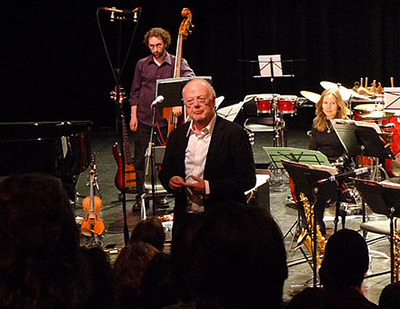
Louis Andriessen
Louis Andriessen's "Hoketus":
 |
(missing audio)
|
Composers on Composing: Where and When to Compose
This week, in lesson 9, four composers share their thoughts on composition.
The question posed to this week's composers is: Where and when do you prefer to compose?
Composers interviewed in week 9:
Ayn Inserto—Jazz composer and pianist
Richard Boulanger—Computer music composer and technologist
Bill Elliott—Film, TV, and musical theater composer
Marti Epstein—Contemporary classical music composer and pianist
Recap
In this lesson we learned how to:
identify unique elements of old and new Jamaican music and compose music using those elements
understand the connection between the Baroque chaconne and its South American origins and compose a nueva chaconne
identify and compose music using rhythms unique to Cuban music
identify unique elements of Andean pan pipe music and compose music using those elements
understand and comment on how the work of a selection of professional composers from South America and the Caribbean are influenced by their culture
In our next lesson we will be getting deeper into forms by learning about the rondo form, sonata allegro form, and theme and variations form.